Datavault AI's Campus Activation Points to a Much Larger Real-Time Engagement Opportunity
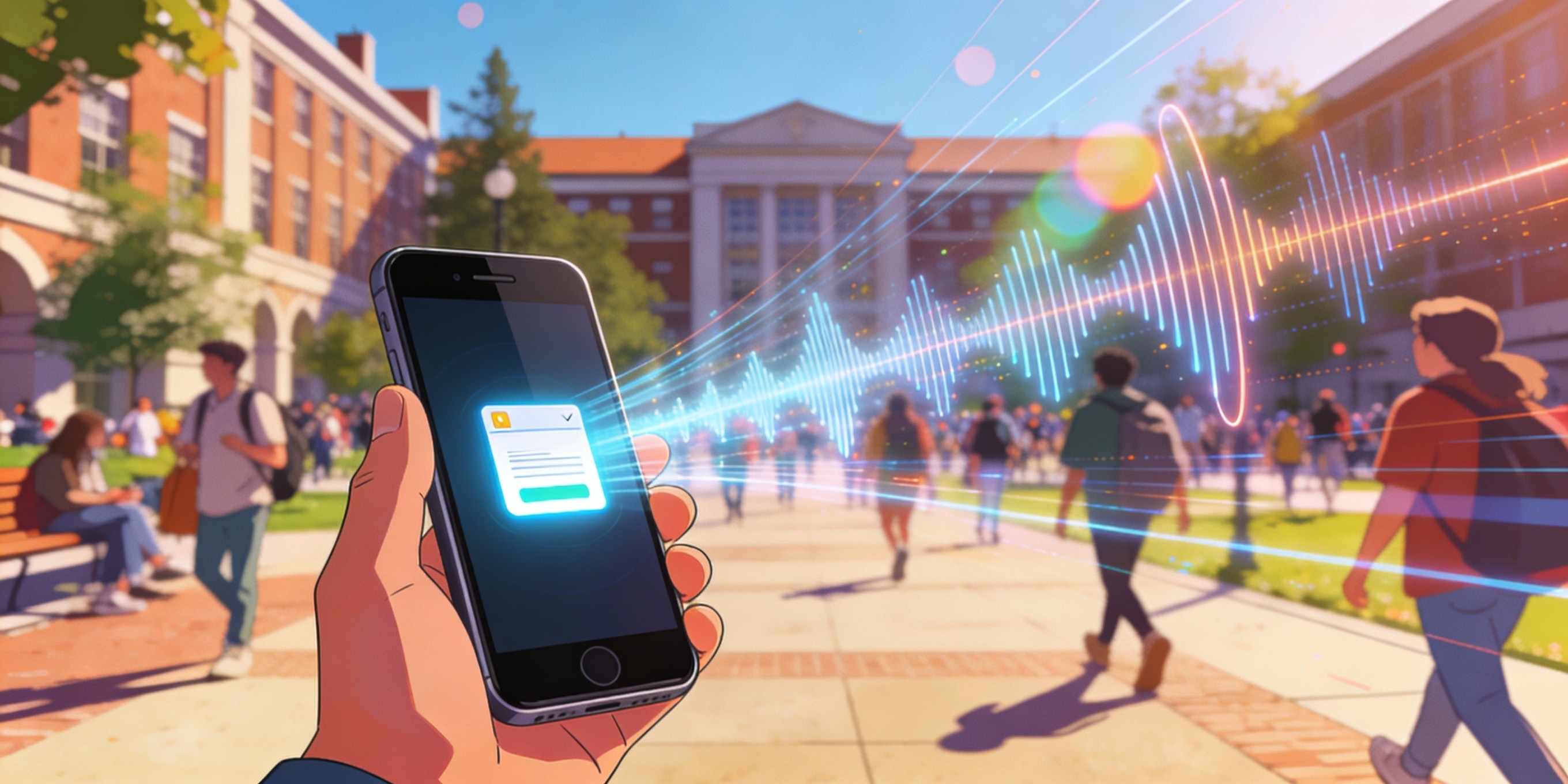
What looked like a simple giveaway on campus this weekend was actually something much bigger. At Liberty University, students received notifications on their phones telling them to go claim prizes. Some reacted immediately and ran to the designated locations, while others ignored it and continued with their day. On the surface, it felt like a fun promotion. Behind the scenes, Datavault AI was demonstrating a fully integrated system designed to capture and understand real-world behavior in real time.
This was not just about sending messages. It was about creating a direct connection between a real-world trigger and a measurable human response.
The first thing to understand is that this was not a traditional text message campaign. Many people assume students simply received a push notification like they would from a retail brand. That is not what happened. The Datavault system uses a patented trigger layer known as ADIO®, which enables signals to be transmitted through an environment and detected automatically by nearby smartphones.
In simple terms, ADIO® embeds data inside sound waves, often inaudible to the human ear, and broadcasts that signal through speakers or physical spaces. A mobile device that is enabled through an application can detect that signal instantly, without requiring the user to scan a code, open an app, or manually initiate any action.
That difference is critical because it removes friction. When people do not have to take extra steps, they are more likely to participate. The experience becomes seamless, and the response becomes more natural.
From the student's perspective, the experience is simple. A student walks across campus, their phone detects a signal, and a notification appears telling them they can claim a reward at a nearby location. They make a quick decision. They either go or they do not. If they go, they receive the prize. That is all they see.
What they do not see is what happens behind the scenes, and that is where Datavault AI's approach becomes meaningful.
Every step in that process creates data. The system records who received the signal, where they were when they received it, and whether they chose to act. It tracks how quickly someone responds and whether they follow through by arriving at the location. It also captures what type of reward or message caused the reaction in the first place.
This is where the difference between traditional marketing and what Datavault AI is doing becomes clear. Most marketing systems rely on estimates. They may know how many people saw a message, but they do not know what those people actually did afterward. Here, the system measures real-world behavior, following the entire chain of action from signal to response to outcome.
To make this easier to understand, consider two students who receive the same notification. David sees the message and walks quickly to the location, arriving within seconds. Susan receives the same message but ignores it and continues with her day. That single moment creates a meaningful distinction. The system now understands that David is highly responsive to this type of real-time incentive, while Susan is not. Both outcomes provide useful information.
Over time, these patterns become more valuable. The system can adjust how it communicates with different individuals. Someone like David may receive more timely or higher-value opportunities because he has demonstrated that he responds. Someone like Susan may receive different types of prompts, or fewer of them, because the system has learned that the same approach does not work for her.
This is not just about sending better messages. It is about learning what drives action.
As more interactions take place, the system begins to identify broader patterns. It can determine what times of day produce the fastest responses, which areas generate the highest engagement, how far people are willing to travel, and what level of incentive motivates movement. These insights allow the system to improve continuously, not just in who it targets, but in how the entire environment is structured.
The backend architecture is what transforms this from a simple engagement tool into a true data engine. Datavault AI organizes these interactions into structured datasets that reflect real behavior. Instead of relying on assumptions, the system builds a record of what actually happened in the physical world. It moves beyond statements like "a message was sent" and instead describes how many people moved, how quickly they acted, and what conditions influenced their decisions.
These data points form a behavioral dataset that becomes more refined and more predictive over time. It can show who is likely to respond, what environments drive engagement, and how digital triggers translate into physical action. This becomes the foundation for turning interaction into something that can be analyzed, understood, and potentially monetized.
One of the most important aspects of this system is how notifications are delivered. These are not random messages being sent to phone numbers, and they are not using emergency broadcast systems. The experience is permission-based, just like any modern mobile application. Simply put, ADIO® is not spamming.
In order for a user to receive a notification, they must already have an application installed on their device and must have granted notification permissions. This could be a university app, an event platform, or a partner application that integrates Datavault AI's technology. Users remain in control at all times and can disable notifications whenever they choose.
What makes this system different is how the notification is triggered.
Instead of sending messages to a predefined list, the system responds to presence. When a user enters an environment where an ADIO® signal is being transmitted, the application recognizes it and delivers a notification in real time. That signal can be based on audio detection, proximity, or other contextual triggers, depending on how the system is deployed.
From the user's perspective, it feels immediate because it is tied to where they are at that moment. From a technical standpoint, it is still a permission-based interaction, activated by context rather than broadcast indiscriminately.
A university campus is one of the most effective environments to demonstrate this model. There is a high concentration of people, constant movement, and a natural willingness to engage with incentives. It provides a controlled setting where behavior can be observed clearly and measured accurately.
At the same time, what was demonstrated at Liberty University only begins to show what this platform can do. The same system can be deployed anywhere large groups gather, including stadiums, concerts, festivals, retail environments, and major sporting events such as the Super Bowl. In those settings, real-time notifications could be used to drive immediate action, whether that means promoting merchandise for a limited window, offering discounted tickets, directing crowd movement, or activating time-sensitive experiences across an entire venue.
In that context, Liberty was not the endpoint. It was a working example of a system that can scale across environments where timing, attention, and action all matter.
The most important takeaway is that the giveaway itself is not the product. The incentive is simply a way to create interaction. Each response contributes to a dataset that reflects how people behave in real-world situations.
It is easy to overlook what is happening because the experience feels simple. Students receive a notification, walk to a location, and collect a reward. That simplicity is intentional. The technology operates in the background while capturing meaningful information.
What Datavault AI demonstrated at Liberty University is a shift in how engagement is measured and understood. ADIO® acts as the trigger, delivering the signal that initiates the interaction. Datavault AI acts as the system behind it, capturing, structuring, and learning from what happens next.
The result is not just better communication. It is a framework for understanding behavior as it happens, rather than guessing after the fact. It turns real-world interaction into usable data, and over time, that data becomes increasingly valuable.
Date
April 26, 2026
Category
Case Study
 Back to Insights Page